
This piece was written for NYC Midnight’s January 2024 Short Story Contest and earned a sixth-place award in the first round. The prompts were Horror (genre) / flea market (setting) / machinist (character). The story had to be no more than 2,500 and written in eight days.
There’s a lot I hated about growing up, primarily Pop’s drinking and trying to explain to kids why my dad didn’t have a job. But even now I really miss those long summer days at the flea market over in Wellfleet.
The market’s big claim to fame was that there had been a continuous exchange of goods on that land for nearly 400 years, dating back to when a bunch of pasty white pilgrims first landed on Cape Cod and traded a handful of beads for food with the Wampanoag, who as it turned out should have slaughtered them as soon as their boots touched the beach.
Anyway, Pop would spend his winters making birdhouses out of gourds and coconuts and shit like that, and my brother Rick and I would tag along as he struggled to sell them at the market each summer weekend. Pop rarely sold more than one or two a week, and more often than not he sold none.
Later on I understood that the flea market was just something for my father to do so he didn’t think about death. He saw a lot of friends get turned into ground beef in Vietnam and did his fair share of killing too, although he never told us much about that second part.
“In a real war you see your friends’ guts hanging out of their bellies,” he would say.
It wasn’t subtle, but it was enough to make sure we never stepped foot in a recruiter’s office.
Eventually I opened my own booth at the flea market, selling comic books and baseball cards and other collectibles. I loved it the first few years, but now instead of a treasure around every corner it’s mostly scammers peddling cheap sunglasses, Chinese knockoffs and 30-year-old VHS tapes.
So I decided this was to be my last summer. I had simply had enough.
My booth, on Lot 37, was sandwiched between a spastic Vietnamese woman named Huyen who sold fake designer purses and a hardware vendor we called The Old Man, who looking back must have been only around fifty when we started calling him that.
Huyen was sweet but loud.
“Oh, you need a purse! Look at that old thing you’re carrying around!” she’d cry as she bounced from one end of her booth to the other, eyeballing worn out middle-aged women and lonely young mothers. “I got just the one for you, beautiful!”
She was relentless. But more often than not, she would make a sale.
The Old Man was the opposite. He rarely said a word, and I literally never saw him sell a single thing.
Yet on any given morning, no matter how early I would arrive, he’d already be there, his cavernous white cargo van already emptied, his tent flaps open, ready for business.
His wares were meticulously arranged, cleaned and polished every day, without fail. And he always seemed to have two of everything, one for sale and one for backup.
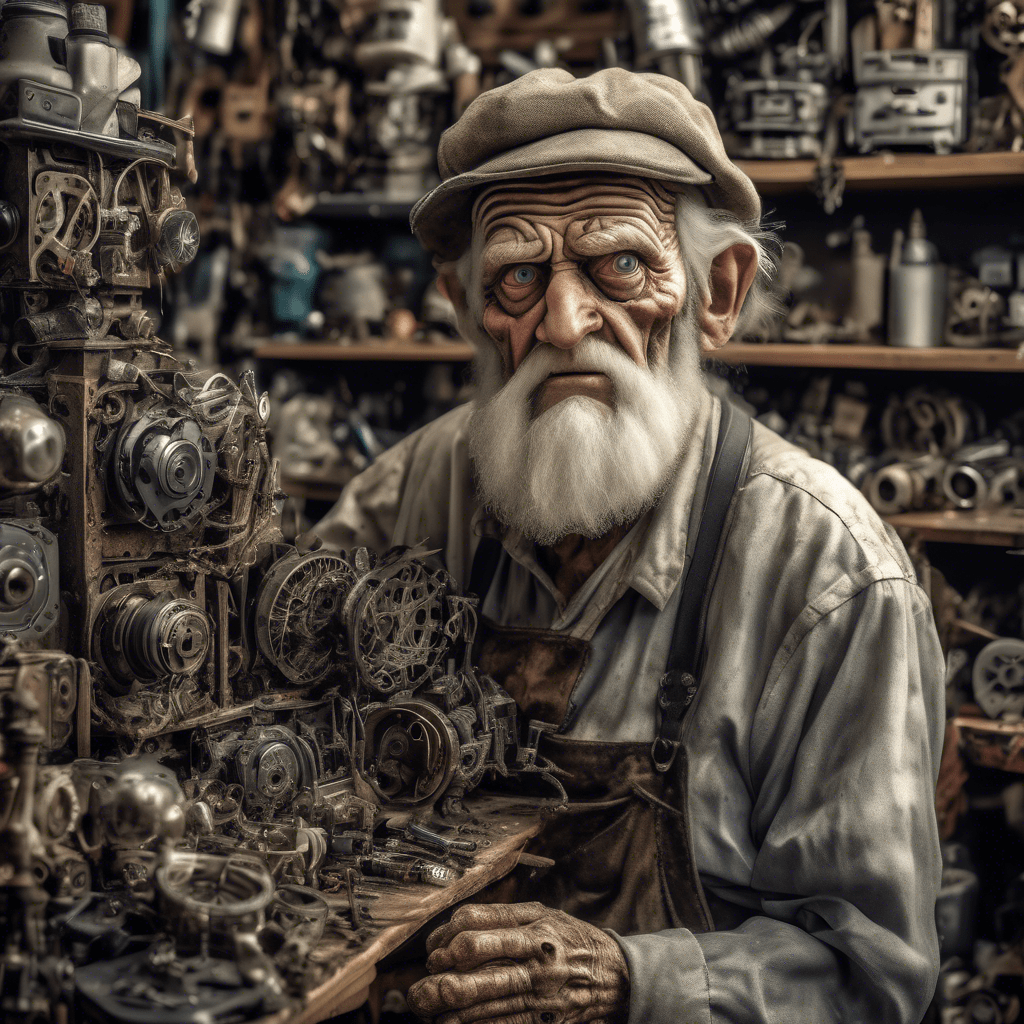
Old grinders, lathes and drills, their bodies weathered but blades sharp, filled a half dozen tables. They were bookended by bins filled with gleaming steel gears, pipes and custom machine parts that I couldn’t even begin to identify, along with several coils of plastic tubing and wiring. On the other side of the booth, a pair of long metal shop shelves held more than fifty jars full of random screws, bolts and other hardware.
When he was ready, The Old Man would secure the back doors of his van with a length of chain and a padlock, slip the key into the breast pocket of his tattered Army jacket, and sink into an old mustard yellow lawn chair in the center of his tent. And there he would remain until the very last customer and the very last vendor left for the day. Sometimes it was unnerving just to watch him, his gnarled hands folded across his lap, his leathery, deeply wrinkled face betraying little to no emotion. Every once in a while he’d light a Dutch Master or wave a midsummer bug away from his face, but other than that he’d just sit there, his beady, uneven eyes continuously surveying the crowd like a soldier on watch.
What he was waiting for, I didn’t know. But it certainly wasn’t for a sale.
For all I knew, he just needed something to do. Like Pop. To get his mind off a war.
By the last weekend of summer, the vendors outnumbered the customers. So whether driven by boredom or curiosity or merely misguided human kindness like those first Wampanoag traders, I strolled over to talk to The Old Man, a familiar mix of gravel and seashells crunching under my feet.
“Any luck today?” I asked, knowing full well that not a single item had been sold.
The Old Man raised his eyes to me but said nothing.
“How much for the dremel?” I asked, pointing to a washed out powder blue power tool. “Would you take twenty bucks?”
The Old Man scrunched up his face and slowly shook his head no.
“Thirty?”
No.
“Fifty?”
No.
“A hundred bucks?!”
Another headshake, but this time there might have been a hint of a smile.
“Do you even want to sell it?” I asked good-naturedly. “I mean come on, it looks like you’ve got two of everything anyway.”
The Old Man raised an eyebrow, the light in his uneven eyes shining a touch brighter.
“Listen, tomorrow is my last day here,” I said. “I’m not coming back next year. So I’d like to buy something from you after all these years. You know, help you out. So what will it take?”
The Old Man raised his eyes to me once again, this time one after the other. It was downright freaky, and I realized I’d never been that close to him before. Because surely I would have noticed that along with his overpowering stench, like a three-day-old bucket of crabs left out in the summer sun.
His voice crackled to life with a deep rumble.
“How about your immortal soul?” he asked, followed by what might have been a giggle.
We had nodded hello to each other many times, but in that moment I could not recall having ever heard him speak, although surely I must have at some point.
I couldn’t help but laugh.
“Sure thing,” I said. “Can you gift wrap it for me?”
“A long time I’ve watched you,” he said. “Tomorrow. Last day you can have it.”
“I’m John, by the way,” I said. “If you don’t remember.”
The Old Man just nodded and started packing up for the day.
*********
The next morning, the final Sunday of the summer market season, I arrived to Lot 37 at precisely 7 a.m. and saw that as usual The Old Man next door, in Lot 38, had already been there.
His tent, tables and van were all in place. But no tools and no parts. And no old man.
It was almost shocking.
“Huyen!” I called to Lot 36. “Have you seen The Old Man over there today?”
She peeked her head out from behind a rack of counterfeit Coach bags.
“Nah!” she shouted. “You want a purse for your wife today? Twenty percent off! Last day special just for you!”
I didn’t have the heart to tell her my wife died of cancer not long after Pop and Rick had their accident, and that I was now hopelessly alone. Instead I strolled over to The Old Man’s lot for the second time in as many days.
The only thing left in the booth, sitting on a weathered table, was an old jam jar with my name on it.
Inside was a key.
And it didn’t take me long to figure out where it belonged.
I had always assumed the cargo bay doors on his van were broken and that’s why he kept them chained together and padlocked.
Now I know better.
As soon as I popped the back doors open, I was met by a cold blast of air and the tang of refrigerant filled my nose.
What I saw before me was at the same time bizarre and beautiful.
But before I could even think “what the hell,” I was falling to the floor.
*******
When I came to, I was face to face with The Old Man.
Groggy but upright.
Still in the van.
The Old Man was upright too, horrifyingly naked and suspended in a contraption of some kind, his skeletal legs and waist strapped down to a framework of metal pipes and a series of tubes running from his body. At first I was afraid for him, until I realized the top half of his body was free and he was busy plugging all of the familiar tools from his booth into a massive bank of batteries at the far end of the spacious cargo bay. One by one he powered his tools on and off, testing them.
When he was satisfied, he connected them, one by one, to the gyroscope-like device he had apparently constructed overnight.
The more my mind cleared, the more I realized that I was also naked and suspended, the only difference being that both of my arms and legs were strapped to the cold metal frame beneath me. Even my chest and head were cinched down tight with thick leather straps.
I tried to squirm, but it was impossible.
And the cold.
My God, it was cold in there.
It was everything The Old Man had never sold. Every gear. Every piece of pipe. Every nut and every screw. Even the powder blue dremel, which now sat at the end of a metal rod and spun not six inches from my right ear, was accounted for.
The true terror set in when I realized the plastic tubing that had sat in his booth not twenty-four hours before had been inserted into my mouth, nose and anus, and a series of wires had been screwed to my fingers and toes.
My mouth was covered by something foul and bitter. I desperately wanted to reach up and claw at it so I could scream.
That’s why he always had two of everything.
For two machines.
All around us they began to whir to life and snap and hiss, a symphony of steel upon steel, each part milled and fitted to perfection.
The Old Man stared at me with those googly eyes and half-muttered, half-coughed.
“How about instead of you giving me your soul,” The Old Man proposed, “I give you mine instead? And then you can have that old dremel.”
He rose up a little as he said this next part, his eyes rotating and finally focusing on me, his nearly translucent skin shimmering in the dim light.
“In fact, you can have it all,” he said, waving his hand dramatically.
A slow and broken smile crept across The Old Man’s face.
“Do you know how many times I’ve done this?” he asked weakly.
I said nothing. Not that I could have any way.
“You will be the … sixteenth. No, seventeenth,” he said, his voice thick with gravel and flem. “It’s easier now. With power.”
He ran a long, bony finger over a length of his machine, where a series of gears and pistons came together.
“Back in the beginning, when the Wampanoag people were here, I had to wait for lightning in the rain,” he said, his coughing and hacking intensifying. “Wooden shunts and reeds. Iron nails. Quadequina was the first. Gave the white man popcorn before I took him.”
With each word, my heart and mind sank further away from reality.
“When you find a host, you must stay near.”
“Protect it.”
“Let it grow.”
The Old Man looked at me almost lovingly and then coughed so hard I thought he would die on the spot.
“Always traders. Never warriors,” he said. “But they took everyone for the big war. Even that weak boy Jacob Crowley who sold cranberries at the farm stand.”
He glanced at the Army jacket that hung on a hook in the corner of the van, along with the rest of The Old Man’s clothing.
“Lucky bastard survived the Nazis,” he said weakly. “Only to return to me.”
The Old Man then sighed as if I were trying his patience.
“I had a couple more years left to wait for you. But if this is your last season, so too must it be mine. In this shell at least,” he said, glancing down at his withered frame.
The Old Man then grunted and fell back into the contraption opposite me, flicking one final switch.
“Fear not, boy. You will remain,” he whispered.
As he said it, The Old Man’s left eye slammed back and forth within its socket and then sagged to a stop.
“Goodbye, Jacob,” he muttered.
Two seconds later, the dremel made contact with my ear. I felt the wet chunks spray across my cheek before I felt the pain.
When the second dremel cut into his ear, the Old Man didn’t scream or even flinch. He smiled.
In concert, a pair of devices crafted out of calipers moved closer to each of us, two ends of a length of tubing between their pincers, strung through the machines in between. One end through my ear. The other through his.
The Old Man took one long, last deep breath, a look of supreme satisfaction creeping across his ancient, blood-stained face.
Then, an electric surge.
Overwhelming.
My last sensation was a burning so powerful, from the inside out, that there was nothing left but the burning.
When it was over, the Old Man fell silent and lifeless.
But even then I didn’t fully comprehend it.
The contraptions slowed to a crawl, with one final tool still moving, a small sharpened grinder, which then cut the straps from both of my arms.
I tried to move but could not, even with the restraints cut.
And yet a moment later I saw my hands moving, undoing the rest of the straps around my body.
I saw my legs stepping off the metal frame, my feet as they touched the ground.
Yet I felt none of it. Controlled none of it.
Wait …
One eye alone was mine to control now.
******
A year has passed.
It’s opening day in Wellfleet.
I watch as The Old Man, a younger man once again, sits down in his booth, surrounded by his tools, his gears and his jars.
Huyen nods hello and asks if I want to buy a purse for my wife.
I can’t tell her that my wife is dead. And all I can do is watch through that one eye, a porthole on a human prison ship.
A customer walks up.
“How much for that drill? Will you take $20 bucks?”
The Old Man shakes my head no.

 Chuck Schading
Leave a comment